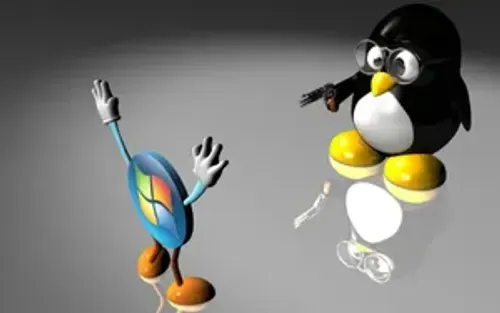
And 2026 is the year the tectonic plates finally moved.
There's a kind of silence that precedes an earthquake. Not the silence of calm — the silence of pressure reaching its limit. That's the silence that has been building around Microsoft's Windows ecosystem for years, and in early 2026, something gave way.
Samsung — one of the largest consumer electronics manufacturers on the planet, a company that sells tens of millions of Galaxy Book laptops annually, a hardware giant whose name is printed on the refrigerators and televisions of a billion households — has begun quietly backing away from Windows. Not with a press release. Not with a keynote. Quietly. Deliberately. The way a company that has done its math walks away from a bad bet before anyone else at the table notices the cards.
This is not a rumour on a Linux forum. This is a structural shift in the global computing market, and it is happening right now.
A Monopoly's Long, Slow Crackup
To understand why Samsung's pivot matters so much, you have to understand what Windows actually is — not technically, but historically. Windows is not just an operating system. It is an agreement. A decades-long pact between Microsoft and the hardware OEMs, enterprise IT departments, governments, and hundreds of millions of individual users who decided, more or less collectively, that Windows would be the default surface of modern computing.
Monopolies feel permanent from the inside. The Windows lock-in was so total, so pervasive, that questioning it felt almost theoretical — like asking whether you could live without English. But agreements can be broken when one party stops holding up their end. And Microsoft, over the past several years, has been burning the goodwill that built their empire with extraordinary efficiency.
The Windows 11 hardware requirements drew the first loud crack. Suddenly, hundreds of millions of perfectly functional machines — machines running Windows 10 without a single complaint, handling enterprise workloads, running home offices, serving schools — were declared obsolete. Not because they couldn't run the software. Because they lacked a specific TPM chip version, because their processor was a generation too old, because Microsoft decided that the upgrade path would be a toll road.
When Windows 10 support ended in October 2025, it left an estimated 240 million users at a crossroads: pay for new hardware, pay for extended support, or find another path. The data shows what millions chose. Searches for "how to install Linux" surged five times over. Distributions like Zorin OS 18 — purpose-built to welcome Windows refugees — hit six-figure download counts, overwhelmingly from users making their first Linux install.
This was not curiosity. This was migration.
The Copilot Catastrophe
But the TPM wall was only one front. The more insidious damage was being done from inside the house.
Microsoft's AI integration strategy for Windows 11 represents one of the most tone-deaf product decisions in the history of personal computing. Copilot was not offered. It was imposed. New laptops shipped with a dedicated Copilot hardware key — a key that users didn't ask for, occupying real estate on keyboards where, say, a useful key might have lived. Background AI processes consumed memory and CPU cycles constantly, inflicting a measurable performance tax on hardware that already felt sluggish under Windows 11's baseline requirements.
Windows Recall — the feature that periodically screenshots everything you do on your machine to build a searchable activity log — became a flashpoint. The privacy implications were immediate and obvious to anyone paying attention. A persistent record of every document you opened, every website you visited, every private conversation displayed on screen — stored locally, but stored — and initially offered with no straightforward opt-out. The backlash forced a partial retreat, but the damage to trust was done.
IT professionals — the people who manage Windows across thousands of machines in enterprises, hospitals, schools, government offices — were not posting angry tweets. They were filing incident reports. Writing internal memos. Beginning the slow, bureaucratic process of evaluating alternatives that enterprise IT departments undertake only when they are genuinely considering a change.
Microsoft was no longer dealing with a PR problem. It was facing a legitimacy crisis.
Then there was the Galaxy Connect incident. Samsung's own companion app on Windows locked thousands of users out of their C drives after a security update. The resolution required administrator access, manual file ownership changes, and running custom batch scripts. Emergency surgery on a system that was supposed to be invisible infrastructure. One broken Microsoft update made Samsung's hardware look compromised — and Samsung's hardware was perfect. The problem was the platform it ran on.
That is the moment an OEM begins doing the math.
Samsung Does the Math
Every major hardware manufacturer that ships Windows machines carries an invisible cost: the support burden of Microsoft's mistakes. When an update breaks a driver, the OEM's support lines ring. When a security patch causes crashes, the OEM's reputation suffers. When Windows Recall generates headlines about surveillance capitalism baked into consumer hardware, that perception bleeds onto the device brand regardless of who built the software.
Samsung sells premium laptops. The Galaxy Book line targets professionals and power users who pay for reliability. The equation is straightforward: if the platform you ship undermines your product's core promise of reliability, you find a new platform.
Samsung's move is not yet a formal pivot. Galaxy Books still ship with Windows. But the signal is unmistakable: Samsung is allowing — and implicitly encouraging — community developers to build Linux drivers for Galaxy Book hardware. Keyboard backlight control. Battery threshold management. Performance profiles. Features that were previously Windows-only exclusives are being unlocked by the open-source community for Linux, and Samsung is watching with visible interest rather than legal hostility.
This is how institutional change happens. Not with announcements. With permission.
When a company the size of Samsung starts clearing the runway for Linux on its flagship hardware, other OEMs pay attention. The boutique Linux-native vendors — System76, Framework, Tuxedo, Slimbook — have been building this future for years. But boutique vendors speak to enthusiasts. Samsung speaks to the mass market. Samsung speaks to the retail shelf, to the corporate procurement department, to the person buying a laptop at a consumer electronics store who has never heard of a kernel.
If Samsung eventually ships a Galaxy Book with Linux pre-installed — even as a single SKU at a lower price point — the conversation around Linux desktop adoption changes permanently.
Linux Was Ready Before Anyone Was Watching
The Linux that exists in 2026 is not the Linux that Munich rolled back from in 2013. That experiment failed for real reasons: immature tooling, fragmented application support, a hardware driver landscape that required expertise to navigate, and an enterprise software ecosystem that had never seriously engaged with the platform. Those conditions have changed fundamentally.
Today's Linux desktop is not a compromise. Distributions like Zorin OS, Linux Mint, and Pop!_OS ship with polished interfaces that genuinely ease the transition for users coming from Windows. The application ecosystem has matured — not just through native Linux software, but through the Flatpak containerisation model that allows applications to run across distributions without fragmentation. LibreOffice has become a credible substitute for most Microsoft Office workflows. Browser-based work runs identically regardless of platform.
Gaming on Linux, once dismissed as a dealbreaker, is no longer a serious objection. Valve's Proton compatibility layer, refined over years of development and stress-tested by the Steam Deck's massive install base, has made the overwhelming majority of the Steam library playable on Linux. The Steam Deck didn't just prove that Proton works — it put Linux in the hands of consumers who would never self-identify as Linux users, who bought the device to play games and discovered they were running a Linux system. That normalisation matters.
The numbers are no longer hobbyist statistics. By mid-2025, Linux had reached approximately 5% of the US desktop market — a share that sounds modest until you recall that it represents millions of users and represents a trajectory, not a ceiling. The infrastructure behind that growth is accelerating: Dell, Framework, System76, Tuxedo, and Slimbook are building Linux-first hardware. Not Linux-compatible — Linux-first. Machines designed and tested with Linux as the native environment, with Windows as the afterthought.
This is the inverse of how it was for thirty years.
The Enterprise Consensus That Always Existed
There is an irony in the narrative that Linux is challenging Windows for desktop relevance. Linux was never absent from computing. It was simply invisible to the people who used it every day.
Every one of the 500 fastest supercomputers on the planet runs Linux. Microsoft Azure — Microsoft's own cloud platform — runs predominantly on Linux infrastructure. Ninety percent of IBM's mainframe customers run Linux. Android, which powers the majority of the world's smartphones, is built on the Linux kernel. The internet's web servers, container infrastructure, embedded systems, network hardware — Linux is the substrate of modern computing, everywhere except the desktop that Windows has defended as its last exclusive territory.
The enterprise desktop, too, is shifting. Germany's Schleswig-Holstein state is migrating approximately 30,000 government computers from Windows and Microsoft Office to Linux and LibreOffice — a decision driven by cost, digital sovereignty, and a refusal to be permanently dependent on a foreign corporation's licensing decisions. This pattern is repeating across European governments, municipalities, and institutions that are collectively reassessing whether Windows dependency is compatible with long-term operational autonomy.
The argument for Linux in enterprise contexts has always been structurally sound. No per-seat licensing fees. No forced upgrade cycles driven by Microsoft's product roadmap rather than operational need. Full auditability of the software stack. The ability to maintain security patches on your own timeline rather than Microsoft's. For organisations running sensitive workloads, the argument is becoming impossible to ignore.
What Comes Next
Microsoft is not standing still. They will attempt to respond — with updated hardware requirements, with revised AI integration strategies, with pricing adjustments designed to retain enterprise customers. Some of these responses may succeed. The Windows ecosystem has enormous installed base inertia, and inertia is genuinely powerful. Enterprise migrations are slow, expensive, and politically complex even when technically straightforward.
But the direction of travel has changed. For the first time in decades, Windows is not the assumed default against which alternatives must justify themselves. The question in 2026 is no longer "why would you use Linux?" It is "why would you stay on Windows?"
That question — once unthinkable, now being asked openly in IT departments, procurement meetings, and national legislatures — is the most significant thing that has happened to the computing landscape in a generation.
Samsung's quiet bet is a signal, not a certainty. The Linux ecosystem still has work to do on application compatibility, on enterprise tooling integration, on the long tail of specialised software that runs critical workflows in industries that have never evaluated alternatives. These are solvable problems, and they are being solved, but they are not yet fully solved.
What is certain is that the monopoly's structural foundation — the assumption that Windows is the only viable choice — has cracked. And once a monopoly's foundations crack, the timeline to collapse compresses in ways that always surprise the people who assumed permanence.
An Empire of Assumptions
Bill Gates built Microsoft's empire on a single insight: that controlling the software platform that runs on the world's computers means controlling how the world computes. That insight was correct, and for thirty years it was executed with a dominance that seemed unassailable.
But empires built on platform lock-in are fundamentally different from empires built on value delivery. Lock-in works as long as the switching cost exceeds the pain of staying. Microsoft's strategy in recent years has been, with remarkable consistency, to increase the pain of staying while simultaneously reducing the friction of switching — by stripping Windows of the qualities that made it the default choice, and by doing so in ways that directly benefit Linux by comparison.
When your operating system photographs your screen to feed your activity into an AI model, users notice. When your updates lock people out of their own file systems, OEMs notice. When your licensing costs become a line item large enough to appear in national budget debates, governments notice.
They're noticing. And some of them are acting.
2026 is not the year Windows dies. It is the year the assumption that Windows is permanent dies. Those are different events, separated by time. But the second one always precedes the first, and the second one has arrived.
Linux is not the future anymore.
It's the now.
Jonathan Brown for Border Cyber Group. The author runs Sable Linux (a custom distro ~ github.com/black-vajra/sablelinux) on custom hardware and has no financial relationship with any Linux distribution, hardware vendor, or Microsoft competitor. The views expressed are based on documented industry developments and publicly available data.
Tags: linux, windows, samsung, open-source, desktop-computing, enterprise, privacy, digital-sovereignty
Member discussion: