What a Walmart Speaker Bar Reveals About Fifty Years of Acoustic Science
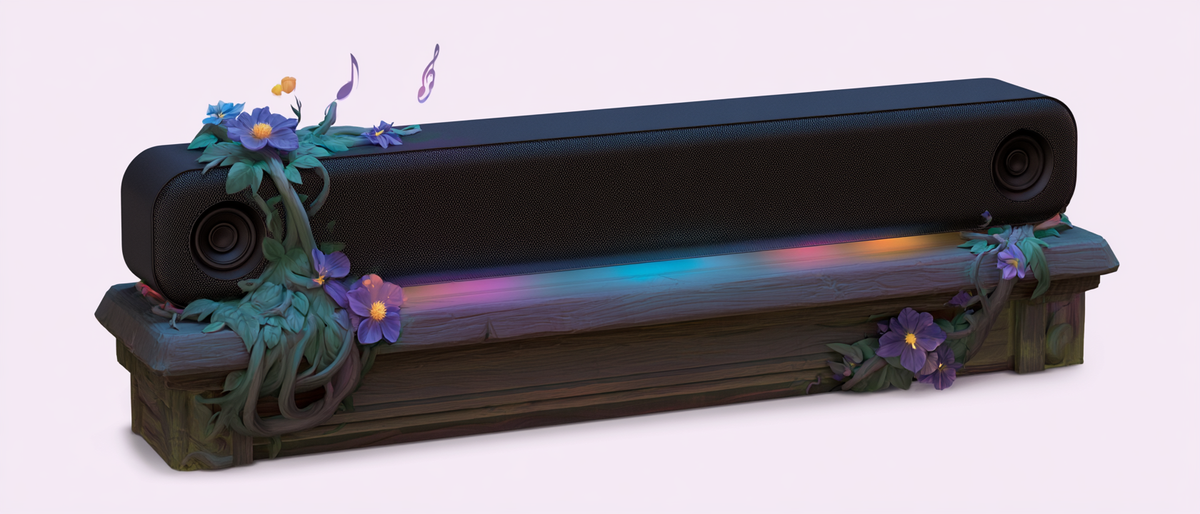
There is a piece of hardware sitting on a shelf — or a countertop, or a desk — in more American homes than most people would care to admit. It is eighteen inches long, two and three-quarter inches high, and two inches deep. It weighs almost nothing. It cost forty dollars at Walmart. The brand is ONN, which is not a company with a legacy, a founder with visionary ambitions, or a marketing budget worth discussing. It is a house brand. A shelf-filler. The kind of thing that ships in a brown cardboard box with instructions translated from Mandarin by someone working from a dictionary.
And it sounds, in ways that matter to the actual human ear in an actual room, better than the best consumer speaker systems most people could afford in 1972.
This is not hyperbole. This is physics, and a reckoning with what fifty years of engineering progress actually means when it lands in your living room at a price point that would have purchased approximately four gallons of gasoline in the Nixon administration.
To understand what the ONN bar is doing, you have to understand what its predecessors were up against. In the early 1970s, the physics of sound reproduction were well understood and genuinely punishing. Bass frequencies — anything below about 150 Hz — require a driver cone to move a lot of air. Moving a lot of air requires a large cone with significant excursion, meaning it has to travel back and forth over a meaningful distance. That cone needs to be housed in an enclosure that manages the rear wave it produces, or the back pressure cancels the front pressure and you get almost nothing. The enclosure has to be tuned — ported, sealed, or horn-loaded — to extend bass response without the whole thing turning into a muddy, resonant box.
The practical result of this physics, in 1972, was that decent speakers were large. A pair of bookshelf speakers considered respectable for home use — the kind reviewed warmly in Stereo Review and recommended by the guys at the hi-fi shop — typically measured twelve to eighteen inches tall and eight to ten inches deep. Floor-standing systems were larger still. The acoustic suspension designs popularized by Edgar Villchur and Henry Kloss at Acoustic Research had established that you could trade efficiency for compactness, but "compact" in that era meant something quite different from what the word implies today.
The JBL L100 — one of the most celebrated bookshelf speakers of the early 1970s, a fixture of recording studios and serious listening rooms alike — measured roughly sixteen inches tall, thirteen inches wide, and ten inches deep. It weighed 35 pounds per cabinet. A pair retailed for approximately $300 in 1972, which the Bureau of Labor Statistics inflation calculator translates to roughly $2,200 today. And the L100 required a capable amplifier to drive it — a separate component purchase that, for anything worth having, ran another $200 to $400 of period money.
All-in-one console stereos — the Magnavox and Zenith and RCA units that populated middle-class living rooms across America — cost $300 to $600 and occupied the floor space of a small credenza. They offered convenience at the expense of performance, and they performed accordingly: frequency response that rolled off aggressively at both ends, driver materials that aged poorly, crossovers that were primitive by any standard, and amplifier sections that were chronically underpowered for the speakers they were tasked with driving. They sounded the way the era's televisions looked: adequate, constrained, and accepted without question because there was nothing to compare them to.
The best the consumer market could reliably deliver, in a form factor approaching what we would today call "compact," cost the equivalent of a month's rent and still needed an equipment rack, a receiver, interconnects, and speaker wire to function.
What has happened since is a convergence of several distinct engineering revolutions, none of them dramatic in isolation, all of them transformative in aggregate.
Driver materials improved first. The polymer and composite cones in a modern inexpensive speaker are stiffer, lighter, and better damped than the pressed paper cones of the early 1970s, which were prone to resonance modes that colored the sound in predictable and unpleasant ways. The surround material — the flexible ring connecting the cone's edge to the basket — used to be foam, which would oxidize and crumble within fifteen to twenty years. Modern surrounds use treated rubber compounds that simply do not do this. A $40 speaker today is not going to need a refoam job in 1989.
Amplifier technology underwent a more dramatic transformation. The Class AB transistor amplifiers that powered most 1970s consumer audio were reasonably efficient, but their power supply requirements were substantial — large transformers, large capacitors, heat sinks — because they dissipated a significant fraction of their power as heat even at idle. Class D amplification, which switches the output transistors on and off at very high frequency rather than running them in linear mode, achieves efficiency figures above 90 percent. The amplifier module in the ONN bar is smaller than a deck of cards and draws almost no power at rest. This is why the entire system, amplifier included, fits in an enclosure two inches deep.
Digital signal processing changed everything else. A modern speaker system can correct for its own deficiencies in real time. The designers of the ONN bar measured its frequency response in an anechoic chamber — or, more likely, in a simulation environment derived from acoustic modeling software that did not exist before the 1990s — and then programmed an equalizer to compensate for the physical limitations of drivers that small in a box that shallow. The bass that a two-inch enclosure cannot physically reproduce through cone excursion alone can be partially recovered through DSP-assisted bass enhancement, psychoacoustic processing, and careful tuning of whatever port or passive radiator the enclosure uses to extend low-frequency output. It is not the same as a large sealed enclosure moving real air, but in a typical room, at typical listening volumes, for typical material — music, television, podcasts, whatever — the perceptual result is surprisingly close.
The signal path itself has also been simplified and improved. A 1972 speaker system received an analog signal that had passed through a preamplifier stage, a tone control circuit, a power amplifier, speaker wire of variable quality, and a passive crossover network — each stage introducing noise, distortion, and phase shifts. A Bluetooth speaker bar receives a digital signal, decodes it internally, applies DSP correction, and drives the drivers with a dedicated amplifier stage per channel. Fewer links in the chain. Each link implemented in silicon rather than in components that drift with temperature and age.
The ONN bar does not image like a pair of well-positioned bookshelf speakers in a well-treated room. It does not produce bass that you feel in your sternum at realistic concert levels. There are things that physics still requires size to accomplish, and no amount of DSP closes that gap entirely. The audiophile community's concerns about lossy Bluetooth codecs, though increasingly overstated as aptX and LDAC have matured, are not entirely without basis.
But frequency response — the basic question of whether the sound coming out of the speaker actually represents the sound that went into it, across the range of human hearing — is a problem that has been substantially solved at the forty-dollar price point. A speaker that measures flat within a few decibels from roughly 80 Hz to 15 kHz is delivering something the best consumer audio of 1972 achieved only with careful room placement, extensive break-in, and the kind of obsessive tweaking that certain personality types find recreational.
Your parents' console stereo, the one that sat in the living room and played the Ed Sullivan Show and Herb Alpert and whatever else was on the radio in 1971, cost — in today's money — somewhere between $1,500 and $4,000 depending on the model and the retailer. It was large, it was heavy, it was technologically constrained in ways its designers understood and simply could not overcome, and it sounded, objectively, worse than the thing you just pulled out of a Walmart bag.
This is the quiet, unremarked miracle of consumer technology: not the flagship products, which are always impressive and always expensive, but the floor of what is possible. The floor has risen. It has risen so far that a retiree on a fixed income can buy something for forty dollars that would have astonished the engineers at JBL or Acoustic Research in 1972 — not because it is better than their best work, but because it is competitive with it, and it weighs less than a hardback novel, and it connects to your phone without wires.
The old folks who remember the console stereos, the furniture-grade speaker cabinets, the separate components lined up on the shelf like a monument to disposable income — they are precisely the ones equipped to appreciate how strange and improbable this is. The young have never known anything else. They assume it. The ones who remember dragging a thirty-five-pound speaker cabinet up three flights of stairs in 1974 know what it means that the thing fits in a shopping bag and costs forty dollars.
It means something happened. Something remarkable and largely unacknowledged. And it is playing, right now, in a living room near you.
Jonathan Brown writes about cybersecurity infrastructure, privacy systems, the politics of AI development, religion, magic, philosophy and many other topics at bordercybergroup.com and aetheriumarcana.org. Border Cyber Group maintains a cybersecurity resource portal at borderelliptic.com
If you wish to support our work, feel free to buy us a coffee! https://bordercybergroup.com/#/portal/support
Member discussion: