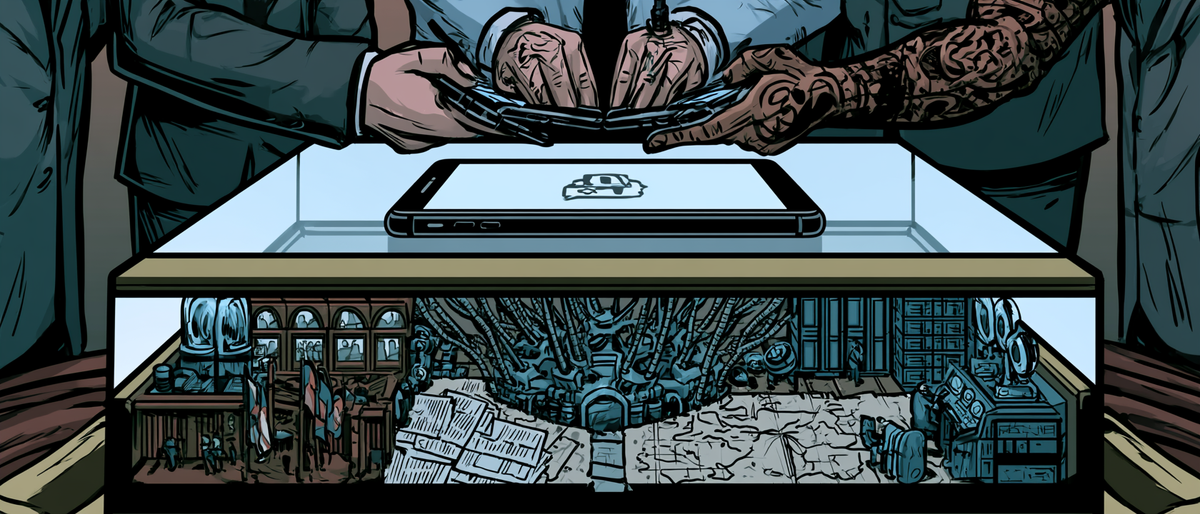
Joseph Cox’s Dark Wire begins with the sort of premise that sounds less like journalism than the pitch for an unusually implausible espionage novel.
The FBI did not merely infiltrate a criminal communications network. It did not simply crack an encryption algorithm, steal a database, bug a server room, or persuade an employee to turn informant. Instead, American law enforcement found itself secretly operating the communications system that thousands of criminals around the world believed was protecting them from law enforcement.
For years, drug traffickers, smugglers, money launderers, and organized crime figures purchased expensive hardened smartphones specifically because they believed those devices were invisible to police. They paid substantial subscription fees. They recommended the phones to friends and business partners. They conducted negotiations, arranged shipments, discussed murders, complained about competitors, sent photographs of drugs and money, and trusted the system precisely because it presented itself as an underground alternative to ordinary consumer technology.
The problem was that the company behind the phones was called ANOM.
And the FBI was sitting inside it.
That is the astonishing central story of Dark Wire, and Cox understands immediately that the technological trick is only half of it. What makes the story memorable is not simply that law enforcement obtained access to encrypted communications. Governments have broken codes, intercepted messages, compromised computers, recruited insiders, and exploited communication systems for as long as such systems have existed.
What was different about ANOM was the inversion.
The FBI did not defeat the enemy’s communications system.
It became the communications system.
That distinction gives Dark Wire its peculiar force.
Cox, a co-founder of the technology journalism outlet 404 Media and formerly a reporter at Vice’s Motherboard, spent years reconstructing the operation through interviews, leaked documents, technical artifacts, law-enforcement sources, criminal defendants, programmers, and people who helped distribute the phones. In his DEFCON presentation describing the investigation behind the book, he explains that he spoke with the people who coded the devices, those who sold them, criminals who used them, FBI personnel, Europol officials, and investigators from several countries.
The result is not primarily a book about cryptography.
It is a book about trust.
And trust, Dark Wire suggests, may be the most important component of any security system.
The Underground Phone Industry
ANOM did not appear in a vacuum.
For years, a specialized industry had developed around so-called encrypted or hardened phones. These devices were often ordinary commercial smartphones that had been substantially modified. Cameras might be removed. GPS functions might be disabled. Conventional applications could disappear. Encrypted messaging systems replaced ordinary communications.
One early company, Phantom Secure, modified BlackBerry devices by removing microphones, cameras, and GPS functionality and adding encrypted email capabilities. The FBI dismantled Phantom Secure in 2018.
But the demand did not disappear.
If anything, the destruction of one provider created a market opportunity for another.
Criminal organizations had discovered something technologically obvious but socially important: secure communications were worth money. A drug trafficker moving millions of dollars in narcotics could easily justify paying hundreds or thousands of dollars for a device that promised to make police interception impossible.
What developed was therefore not simply a collection of encrypted apps. It was an ecosystem.
There were developers, distributors, resellers, device managers, logistics networks, support systems, subscription models, and brands. Some companies developed reputations within particular criminal communities. Dealers recommended certain systems. Smugglers trusted particular vendors. Phones became status objects.
Cox’s account of this world is fascinating because criminal organizations repeatedly begin to resemble ordinary businesses.
They need inventory.
They need technical support.
They need reliable networks.
They need billing systems.
They need customer service.
And, above all, they need confidence in the product.
The FBI recognized that confidence could itself become an attack surface.
The Perfect Product
The ANOM devices were designed to look convincing.
Cox describes phones based on Google Pixels, Samsung Galaxy devices, and other Android hardware. A custom operating system called ArcaneOS provided the hardened environment. ANOM’s messaging application was hidden behind an innocuous calculator. Entering a particular calculation caused the messaging interface to appear.
There were scrambled PIN pads so that someone watching over a user’s shoulder could not easily identify the unlock pattern. There were wipe codes and decoy PINs. One PIN could expose an apparently harmless collection of applications, giving the impression that the owner merely possessed an ordinary phone.
Some of these features were genuine security measures.
Others amounted to security theater.
But that hardly mattered.
They looked secure.
And in the underground marketplace that appearance became part of ANOM’s credibility.
Here Dark Wire exposes an uncomfortable truth about cybersecurity far beyond organized crime. Most users cannot personally audit the cryptographic architecture of the systems they depend upon. They do not inspect source code, analyze firmware, verify server infrastructure, examine build pipelines, or independently test encryption protocols.
They trust reputations.
They trust interfaces.
They trust other users.
They trust branding.
Criminals using ANOM were no different.
If respected traffickers were using it, the device seemed trustworthy.
If resellers with connections to organized crime vouched for it, the device seemed trustworthy.
If the operating system looked hardened, the device seemed trustworthy.
If police apparently could not read it, the device seemed trustworthy.
The FBI’s great achievement was therefore less technological than psychological.
It constructed a believable mythology of security.
The Invisible Participant
Behind that mythology was an extraordinarily simple idea.
Messages sent through ANOM were secretly copied to an additional recipient.
Cox describes the mechanism as effectively inserting an invisible participant into every conversation. What users experienced as a private exchange between Alice and Bob was actually closer to a group conversation in which law enforcement silently occupied the third seat.
That architecture produced an intelligence windfall.
The FBI could see conversations.
It could map relationships.
It could identify groups.
It could study patterns.
It could follow people geographically.
The operating system itself reportedly supplied location information associated with messages even though users believed GPS functionality had been disabled.
Pictures supposedly altered to conceal sensitive portions could allegedly be obtained in their original form. Voice recordings that users thought had been distorted could be reconstructed in their original state.
ANOM therefore became something considerably more powerful than a wiretap.
It became a sensor network embedded within organized crime.
Messages revealed not simply what individuals said but who communicated with whom, where they were, when they communicated, and how separate criminal organizations intersected.
Cox describes analysts visualizing networks of contacts and group conversations, producing exactly the sort of relationship mapping familiar from intelligence analysis.
That is the point at which Dark Wire stops feeling like a conventional crime story.
The FBI had stumbled into something resembling a global intelligence platform.
The FBI as Startup Founder
Perhaps the strangest element of the entire episode is the extent to which law enforcement had to keep ANOM functioning as an actual business.
A fake technology company still needs working technology.
Phones had to be configured.
Servers had to remain operational.
Customers expected reliability.
Subscriptions needed management.
Inventory had to move.
Technical problems had to be fixed.
Resellers needed devices.
Developers had to write software.
Cox describes a sprawling distribution hierarchy involving major distributors, regional resellers, and roughly 150 agents selling devices around the world, most apparently unaware that the system ultimately served the FBI.
At one point the operation reportedly consumed so many Google Pixel phones that obtaining enough refurbished devices became difficult. Cox recounts an episode in which the FBI physically transported additional phones to Europe so that the criminal distribution network could continue expanding.
It is difficult to imagine a more surreal form of undercover work.
Government agents were effectively worrying about supply-chain logistics for a criminal communications company whose customers were unknowingly providing evidence against themselves.
The better the company performed, the more valuable the surveillance became.
The more criminals trusted ANOM, the more criminals recommended it.
The more they recommended it, the larger the intelligence network grew.
It was surveillance driven by network effects.
Silicon Valley would recognize the business model immediately.
When Success Becomes Dangerous
One of the most interesting themes running through Cox’s account is that ANOM eventually became almost too successful.
The operation expanded dramatically after competing encrypted-phone platforms came under pressure. Sky ECC, once enormously popular among organized crime groups, was compromised during a separate European investigation. As alternatives disappeared, ANOM became increasingly attractive.
The FBI suddenly found itself receiving enormous quantities of information from users scattered across the world.
Criminal distributors even began expanding the network themselves.
In one of the strangest twists, participants discovered how to reproduce the equipment used to provision ANOM devices. That meant the distribution system could scale beyond the FBI’s direct logistical control. Cox describes one agent comparing the experience to piloting a plane that was trying to crash: the operation had accumulated momentum of its own.
The metaphor is revealing.
ANOM was no longer merely a sting.
It had become an ecosystem.
And ecosystems are difficult to control.
The FBI might have created the trap, but thousands of participants were now expanding it themselves.
That is precisely what made the operation so productive.
It is also what makes the story unsettling.
The Strange Geography of Surveillance
The legal architecture surrounding ANOM may ultimately prove more historically important than the technical architecture.
Cox reports that the interception infrastructure depended upon cooperation with a foreign jurisdiction, allowing messages to be collected outside the United States and then transferred to the FBI. He identifies Lithuania as the country involved in this portion of the operation.
Whatever one concludes about the legality of that arrangement, it introduces a question that extends far beyond narcotics investigations.
Modern communications do not respect national borders.
Servers reside in one country.
Companies are incorporated in another.
Users live in dozens more.
Cloud infrastructure shifts constantly.
Intelligence agencies cooperate across alliances and treaties.
Law written for geographically bounded searches now operates inside globally distributed technical systems.
ANOM existed precisely at that intersection.
Cox notes that U.S. investigators contemplated monitoring ANOM devices inside the United States but that higher levels of the Justice Department did not approve the domestic interception plan.
That fact deserves attention.
The operation apparently reached a boundary.
The people running it wanted to cross that boundary.
The government ultimately declined.
At least in that instance.
For readers interested in surveillance policy, this may be the most important passage in the entire story.
It reveals that the technological capability existed before the legal consensus did.
History suggests that such gaps rarely remain unresolved forever.
The Encryption Debate Turned Inside Out
For decades, law-enforcement agencies have warned of the problem commonly described as “going dark.”
Strong encryption, the argument goes, increasingly prevents investigators from accessing communications even when they possess lawful authority to search them.
Technology companies and civil-liberties advocates respond that deliberately weakening encryption creates vulnerabilities that cannot reliably be reserved for legitimate authorities. A backdoor created for police is still a backdoor, and backdoors can eventually be discovered or exploited by criminals, foreign governments, or intelligence services.
ANOM offers a bizarre experiment within that debate.
Here, for once, law enforcement actually possessed the backdoor.
Not hypothetically.
Not as a proposed technical standard.
Not through legislation.
It existed.
And it worked spectacularly.
Cox therefore asks an unusually useful question: what actually happens when law enforcement gets the access it has spent years requesting?
The answer is complicated.
ANOM undoubtedly exposed serious criminal activity. Investigators intercepted evidence of drug trafficking, violence, smuggling, financial crimes, and conspiracies spanning multiple countries.
But the system also demonstrated the inherent expansionary tendency of surveillance infrastructure.
Once access exists, enormous quantities of information become available.
Once enormous quantities of information become available, analysts develop tools to search, translate, classify, and correlate it.
Once those tools exist, the surveillance system stops being merely a mechanism for investigating known suspects.
It becomes an intelligence environment.
That difference matters.
Who Is Inside the Net?
Cox mentions discovering that ANOM communications included lawyers who were not themselves suspected of crimes but were advising criminal defendants or clients.
That observation points directly toward the deepest problem with platform-level surveillance.
Criminal organizations do not exist in hermetically sealed social bubbles.
They communicate with lawyers.
Family members.
Doctors.
Business associates.
Employees.
Journalists.
Government officials.
Victims.
Informants.
Innocent acquaintances.
The broader the surveillance system becomes, the more difficult it is to maintain a meaningful distinction between observing a criminal network and observing the society surrounding that network.
This problem becomes much more serious when the communications technology being targeted is not a specialized criminal platform.
Cox ends his DEFCON presentation by raising exactly that concern.
After ANOM and other hardened-phone companies disappeared, some criminals reportedly migrated toward ordinary privacy technologies such as Signal and hardened Android systems. He asks what happens when organized crime increasingly uses the same communication systems relied upon by journalists, activists, technologists, dissidents, and ordinary citizens.
That question remains unresolved.
And it transforms Dark Wire from a fascinating historical account into a warning about the future.
The Real Backdoor
The genius of ANOM was that the FBI did not need to defeat encryption mathematically.
It defeated the assumptions surrounding encryption.
That distinction deserves to be remembered.
Security discussions often concentrate on algorithms: AES, RSA, elliptic curves, key lengths, vulnerabilities, exploits.
But cryptography exists inside systems.
Systems exist inside organizations.
Organizations exist inside societies.
And societies operate on trust.
ANOM attacked trust.
The criminals trusted the distributors.
The distributors trusted the software.
The users trusted the phones.
The phones trusted the servers.
And somewhere behind those servers sat the FBI.
In that sense Dark Wire belongs alongside the best histories of intelligence operations because its central lesson is timeless.
You rarely need to break the fortress if you can persuade your opponent to walk through a door you built for him.
After Dark Wire
Toward the end of his DEFCON talk, Cox recounts hearing an FBI agent refer to looking forward to another iteration of the operation.
That remark lingers after the rest of the story is finished.
ANOM worked.
It worked spectacularly.
And institutions tend to repeat techniques that work.
Whether that next iteration resembles another encrypted-phone company, a compromised platform, a supply-chain operation, targeted device exploitation, international intelligence sharing, or something we have not yet seen is another question entirely.
That question deserves a separate investigation.
But Dark Wire gives us the starting point.
The important lesson is not merely that criminals made the foolish mistake of buying phones secretly controlled by the FBI.
The important lesson is that modern surveillance is becoming infrastructural.
The most powerful observer may not be the person listening outside the room.
It may be the person who built the room.
And that is what makes Joseph Cox’s Dark Wire far more interesting than the extraordinary police operation advertised on its cover.
It is the story of what happens when law enforcement stops trying to peer through the window and quietly becomes the architect of the house.
Jonathan Brown for Border Cyber Group
© 2026 Border Cyber Group. All rights reserved.
Member discussion: